Welcome to Infalex
The job market is constantly evolving, and what worked for resumes a few years ago might not cut it today. In 2026, the game is all about keywords – those specific terms that act like digital breadcrumbs, guiding recruiters and Applicant Tracking Systems (ATS) directly to your profile.
At Infalex, we understand the frustration of feeling unheard in your job search. This guide is designed to empower you with the knowledge of which keywords truly matter, how to find them, and most importantly, how to weave them naturally into your resume to secure those coveted interview calls.
The Keyword Revolution: Why They Matter More Than Ever in 2026
Forget the old days where a visually stunning resume was enough. In 2026, the first gatekeeper for your application isn’t a human, but an increasingly sophisticated Applicant Tracking System (ATS). These AI-powered systems scan, parse, and rank resumes based on their relevance to a job description. The primary metric for relevance? Keywords.
If your resume lacks the right keywords, it’s highly likely to be filtered out before a human ever lays eyes on it. This isn’t just about technical roles; administrative, marketing, sales, and even creative positions now rely heavily on keyword matching. Mastering keywords is no longer an advantage; it’s a necessity.
Here’s why they’re crucial:
-
ATS Filtering: Keywords are the primary way ATS identifies suitable candidates.
-
Recruiter Search: Human recruiters use keywords to search internal databases for candidates.
-
Demonstrates Fit: Properly used keywords show you understand the role and possess the required skills.
Understanding Different Types of Keywords
Not all keywords are created equal. To effectively optimize your resume, you need to understand the different categories and how recruiters typically look for them.
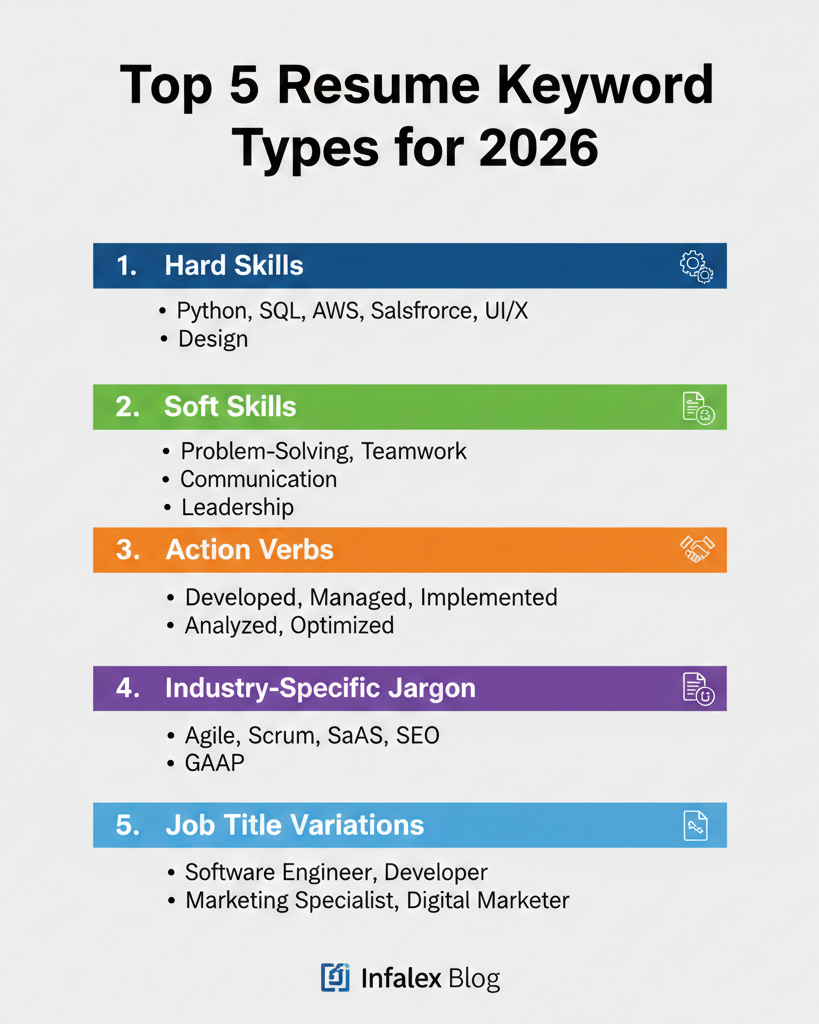
1. Hard Skills (Technical & Measurable)
These are the specific, teachable abilities that are often quantifiable. They are the backbone of your “Skills” section and frequently appear in job descriptions.
-
Examples: Python, SQL, AWS, Salesforce, Google Analytics, UI/UX Design, Project Management, Financial Modeling, Digital Marketing, Data Analysis, CAD Software.
-
Why they’re critical: They directly address the technical requirements of a role.
2. Soft Skills (Interpersonal & Behavioral)
While harder to quantify, soft skills are essential for workplace success and are increasingly being screened by advanced ATS. These demonstrate how you work with others and approach challenges.
-
Examples: Problem-Solving, Teamwork, Communication, Leadership, Adaptability, Critical Thinking, Time Management, Customer Service, Collaboration, Innovation.
-
Why they’re critical: Recruiters look for well-rounded individuals who can thrive in a team environment.
3. Action Verbs (Dynamic & Impactful)
These aren’t just buzzwords; they’re the verbs that transform passive descriptions into powerful statements of accomplishment. They show what you did and what impact you had.
-
Examples: Developed, Managed, Implemented, Analyzed, Optimized, Led, Coordinated, Designed, Streamlined, Mentored, Achieved, Increased, Reduced.
-
Why they’re critical: They highlight your achievements and responsibilities effectively, making your experience more compelling.
4. Industry-Specific Jargon & Acronyms
Every industry has its own language. Using these terms correctly shows you’re an insider.
-
Examples (Tech): Agile, Scrum, DevOps, API, SaaS, CRM, SEO.
-
Examples (Finance): GAAP, KYC, ESG, ROI, P&L.
-
Why they’re critical: They demonstrate industry knowledge and expertise.
5. Job Title Variations
Recruiters might search for multiple variations of a job title. Be aware of common synonyms.
-
Examples: Software Engineer, Software Developer, Developer; Marketing Specialist, Marketing Coordinator, Digital Marketer.
-
Why they’re critical: Broadens the net for your resume to be found.
Here’s a quick overview of keyword types:
How to Find the Right Keywords (The “Detective” Method)
You don’t need a crystal ball to find the best keywords; you just need to know where to look. The best source for keywords is always the job description itself.
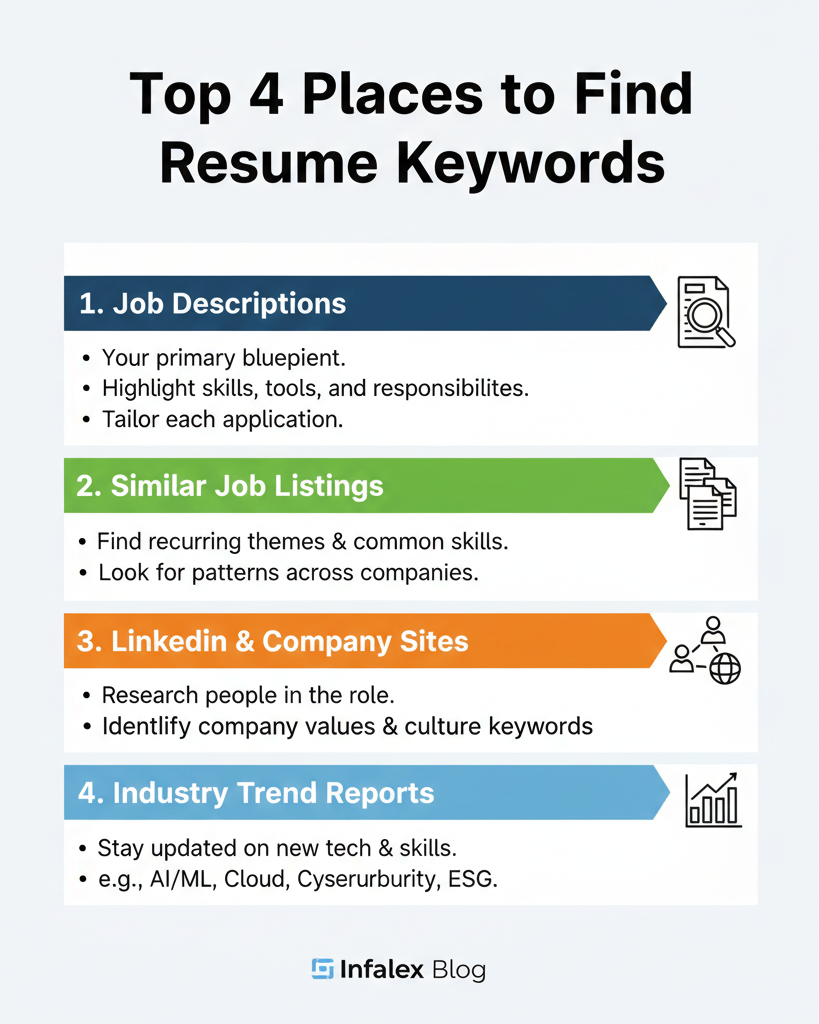
Step 1: Analyze the Job Description
This is your primary blueprint. Read it carefully, highlighting or noting down all the skills, tools, responsibilities, and qualifications mentioned.
Example Job Description Snippet: “We are seeking a Data Analyst with strong proficiency in Python (Pandas, NumPy) and SQL to join our growing team. The ideal candidate will be responsible for data extraction, analysis, and generating actionable insights to support strategic decision-making. Experience with Tableau for data visualization and strong problem-solving skills are highly valued. Familiarity with Agile methodologies is a plus.”
Keywords identified: Data Analyst, Python, Pandas, NumPy, SQL, data extraction, analysis, insights, Tableau, data visualization, problem-solving skills, Agile methodologies.
Step 2: Research Similar Roles
Look at 3-5 other job descriptions for similar positions at different companies. You’ll start to see common themes and recurring keywords that might not be in every single job posting but are generally expected in the role.
Step 3: Utilize LinkedIn and Company Websites
-
LinkedIn Look at the profiles of people currently holding the role you want. What skills do they list? What keywords do they use in their summaries and experience sections?
-
Company Website: Explore the “About Us” or “Careers” section. What are the company’s values? Do they emphasize certain methodologies (e.g., “customer-centric,” “innovative,” “collaborative”)? These can be excellent soft skill keywords.
Step 4: Use Online Keyword Tools (Sparsely)
While not as precise as manual analysis, tools can sometimes offer supplementary ideas. However, rely primarily on the actual job descriptions.
Here’s a visual summary of where to hunt for keywords:
Strategic Placement: Where to Put Your Keywords
Finding keywords is only half the battle; placing them strategically throughout your resume is where the real magic happens. Remember, the goal is natural integration, not keyword stuffing.
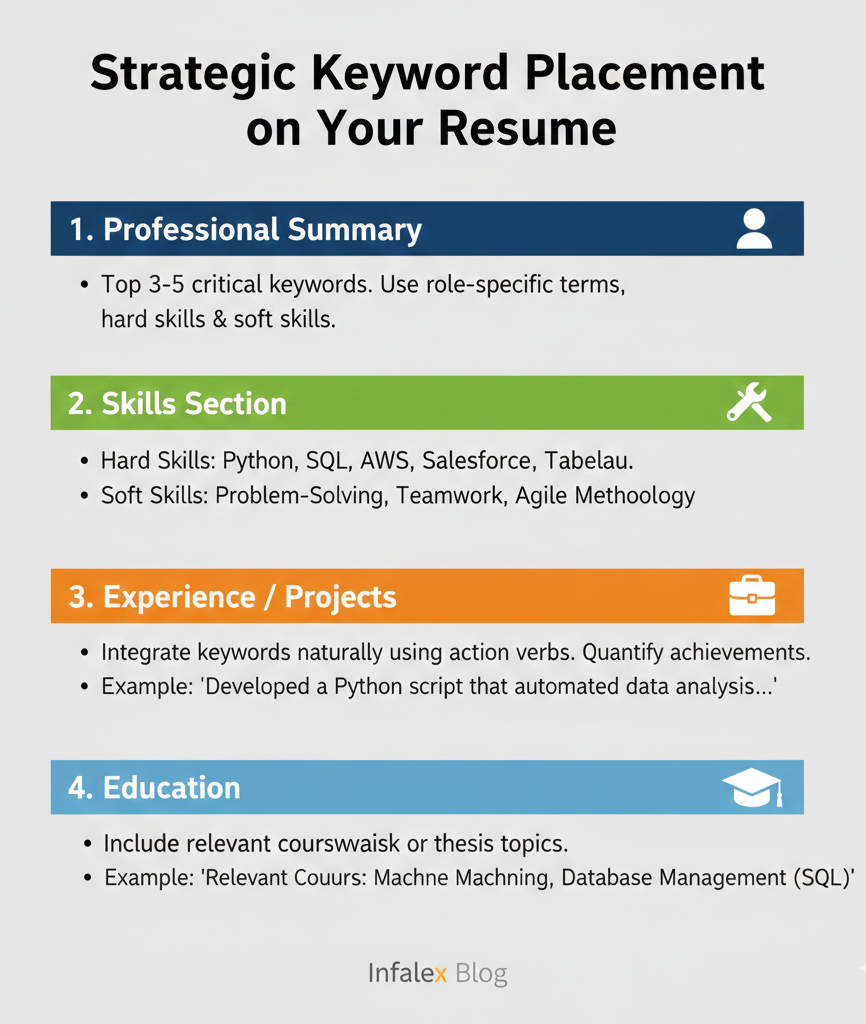
1. Professional Summary / Objective
This is your prime real estate. Incorporate 3-5 of the most critical keywords relevant to the role.
Example (Marketing): “Results-driven Digital Marketing Specialist with expertise in SEO, Content Strategy, and Google Analytics. Successfully managed social media campaigns increasing engagement by 20% and driving traffic to lead generation forms.”
2. Skills Section (The Keyword Goldmine)
This section is explicitly designed for keywords. List both your hard and relevant soft skills clearly.
Format:
-
Programming Languages: Python, Java, C++, JavaScript
-
Databases: SQL, MongoDB, PostgreSQL
-
Tools: AWS, Docker, Kubernetes, Jira, Figma
-
Marketing Tools: Google Analytics, SEMrush, HubSpot, Mailchimp
-
Soft Skills: Problem-Solving, Team Collaboration, Communication, Agile Methodology
Pro Tip: Be specific. Instead of “Microsoft Office,” list “Excel,” “PowerPoint,” “Word.”
3. Experience / Projects Section
This is where you demonstrate how you used the keywords. Use action verbs and quantifiable results.
Example (Project for a Fresher): “Developed a full-stack e-commerce application using React, Node.js, and MongoDB. Implemented secure user authentication and integrated Stripe API for payment processing. This project enhanced my problem-solving skills and proficiency in Agile development.”
4. Education (If Applicable)
If you’re a recent graduate, include relevant coursework or projects that used specific keywords.
Example: “B.Tech in Computer Science, GPA: 8.5/10.
Relevant Coursework: Data Structures & Algorithms, Machine Learning, Database Management (SQL).”
Here’s how keywords are typically distributed:
Common Keyword Mistakes to Avoid in 2026
While keywords are crucial, misusing them can do more harm than good. Avoid these common pitfalls:
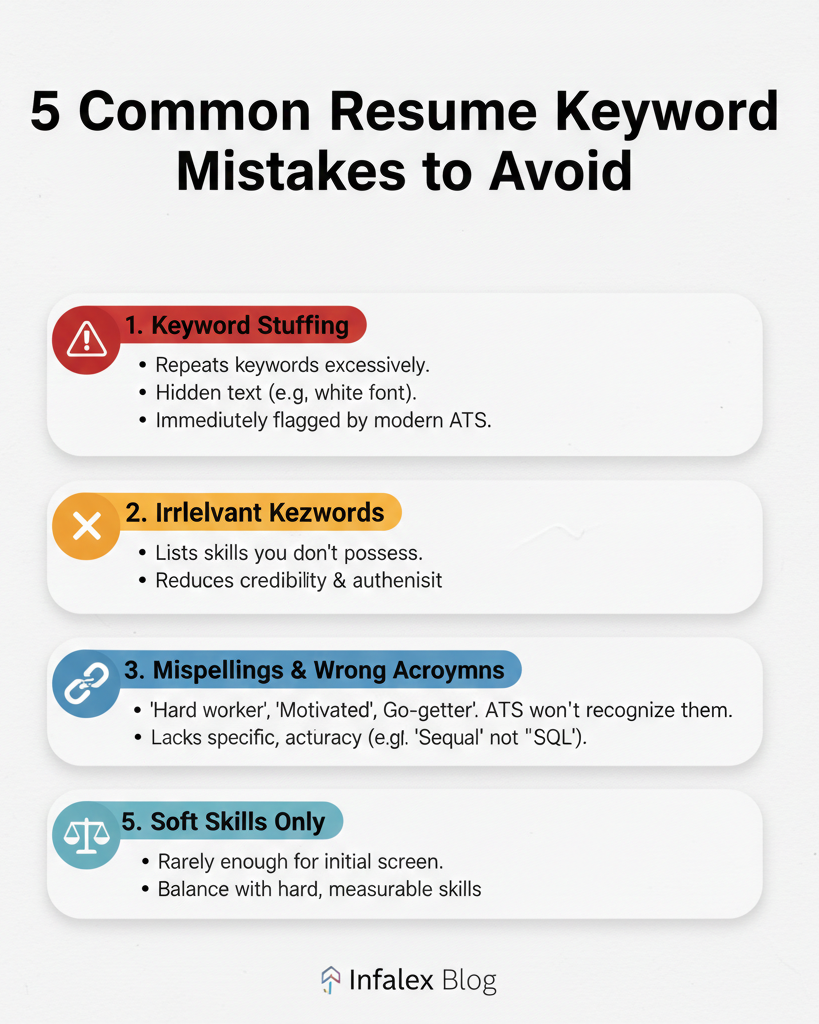
1. Keyword Stuffing
This is the cardinal sin. Repeating keywords excessively or listing them in a hidden “white text” section (a tactic from a bygone era) will almost certainly get your resume flagged and rejected by modern ATS. AI-driven systems are smart enough to detect this and will penalize you.
2. Irrelevant Keywords
Only include keywords that genuinely reflect your skills and experience. Don’t add “Artificial Intelligence” if you’ve only read an article about it. Authenticity is key.
3. Generic Buzzwords
Avoid vague terms that don’t convey specific skills. “Hard worker,” “motivated,” and “results-oriented” are fine as general descriptions but don’t substitute for specific, actionable keywords. Instead of “good communication skills,” try “Presented technical concepts to non-technical stakeholders.”
4. Incorrect Spelling or Acronyms
A misspelled keyword is an invisible keyword to an ATS. Double-check all spellings and ensure you use the correct acronyms (e.g., “SQL” not “Sequel”). If an industry term has a common acronym and its full form, it’s often best to include both once (e.g., “Search Engine Optimization (SEO)“).
5. Over-reliance on “Soft Skills” Alone
While important, soft skills rarely get you past the initial ATS filter for technical roles. Ensure your hard skills are prominent and well-articulated.
Here’s a quick glance at what not to do:
Leveraging Tools for Keyword Optimization
While manual analysis is paramount, a few tools can aid in ensuring your resume is keyword-rich and ATS-friendly.
1. ATS Scanners / Resume Checkers
Several online tools allow you to upload your resume and a job description to get a “match score.” These can highlight missing keywords or areas for improvement. Use them as a guide, not a definitive answer.
Popular Tools: Resumetra, Jobscan, Resume Worded, VMock (often available through universities).
2. LinkedIn’s Skill Endorsements
The skills you list on LinkedIn are valuable keywords. Ensure your resume mirrors these, and consider getting endorsements from peers or mentors to validate your proficiency.
3. Google Trends
If you’re unsure about the most current terminology for a skill or technology, Google Trends can show you what terms are gaining traction or becoming obsolete. This is particularly useful for emerging technologies.
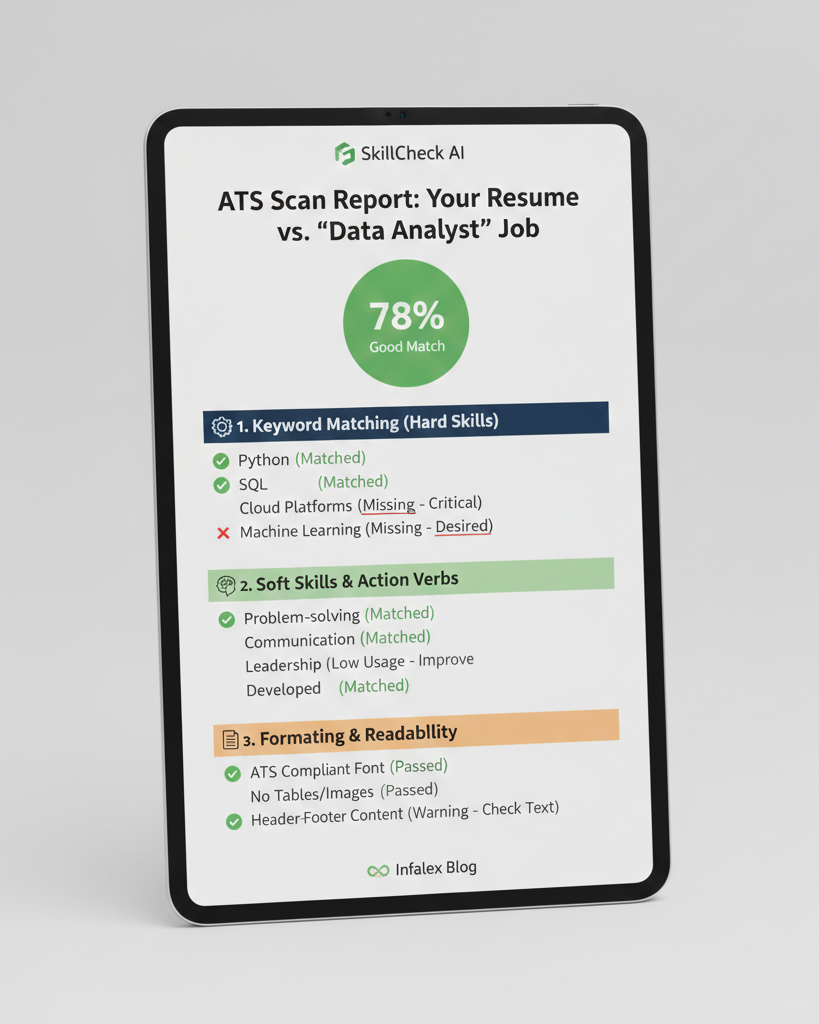
Here’s an example of how an ATS scan might look:
The Human Element: Keywords for Recruiters
While ATS optimization is crucial, remember that a human will eventually read your resume. Keywords aren’t just for bots; they also help human recruiters quickly grasp your qualifications.
Recruiters spend an average of 6-7 seconds scanning a resume. Well-placed, bolded (judiciously), and clear keywords make their job easier and increase your chances of being noticed. They’re looking for quick confirmation that you possess the skills they need.
Think about the “story” your resume tells. Keywords should support that narrative, not just be a random list. They should seamlessly integrate into your achievements and responsibilities.
Tailoring for Success: The Golden Rule
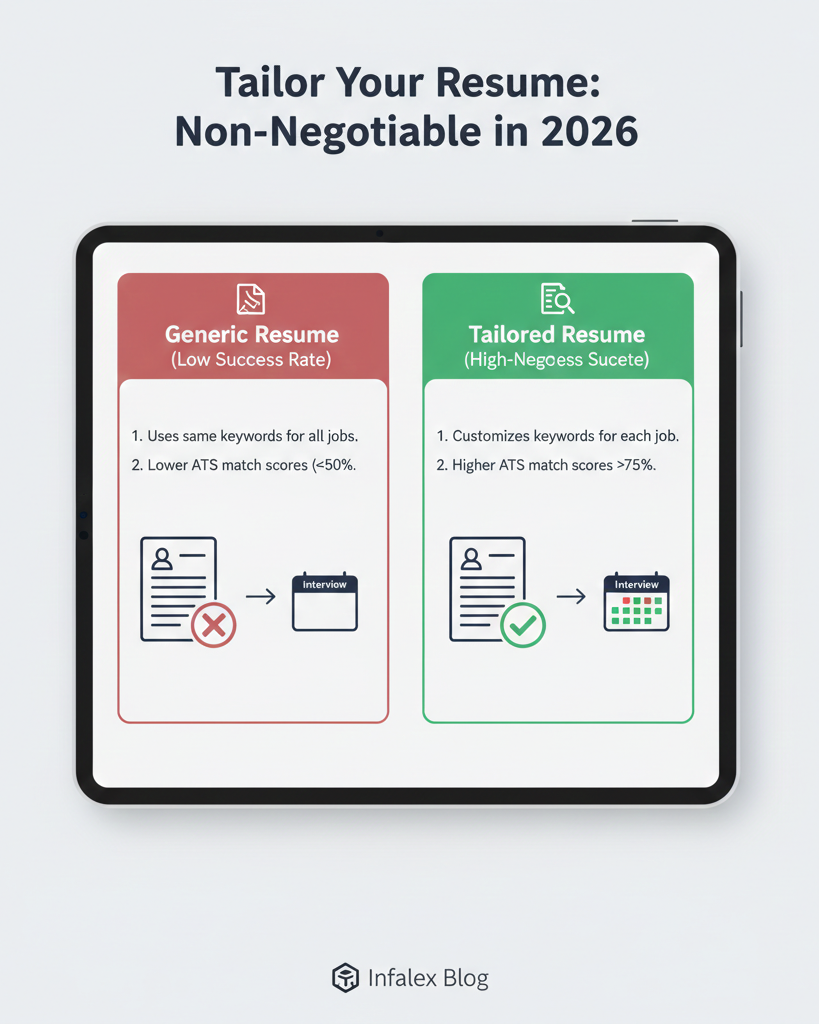
The single most effective strategy for keyword optimization is tailoring your resume for each application. This means:
-
Read the Job Description: Identify unique keywords for that specific role.
-
Adjust Your Skills Section: Ensure the most relevant keywords appear at the top.
-
Tweak Project/Experience Bullet Points: Rephrase accomplishments to include the language used in the job post.
-
Update Your Summary: Ensure it reflects the top 2-3 most critical keywords.
This isn’t about creating a brand new resume every time, but rather making strategic, targeted edits. It takes a little more time, but the return on investment in terms of interview invitations is significantly higher.
Here’s why tailoring is non-negotiable in 2026:
Frequently Asked Questions (FAQs)
Q: Do I need to use the exact spelling of a keyword, or can I use synonyms?
A: Always use the exact spelling as it appears in the job description first. While some advanced ATS can recognize synonyms, it’s safer to use the precise term. If a term has a common acronym, it’s a good practice to include both (e.g., “Artificial Intelligence (AI)”).
Q: Should I include keywords in my cover letter too?
A: Absolutely! Your cover letter is another excellent place to reinforce your fit for the role by naturally integrating relevant keywords and phrases from the job description. This shows consistency and further reinforces your qualifications.
Q: What if I don’t have all the keywords listed in a job description?
A: Be honest. Never lie about possessing a skill. Instead, focus on the keywords you do have and highlight transferable skills or related experiences. For example, if they ask for “Salesforce” and you’ve used “HubSpot,” you can emphasize your “CRM software proficiency” and quick learning ability.
Q: Are there any universal keywords that are always good to include?
A: While customization is key, certain soft skills like “Problem-Solving,” “Communication,” “Teamwork,” and “Leadership” are almost universally valued. For hard skills, it depends entirely on your industry and target roles, but common software (e.g., Microsoft Excel, Google Suite) or widely used programming languages (e.g., Python, SQL) can often be beneficial.
Q: Can I put keywords in the header or footer of my resume?
A: Avoid placing critical information, including keywords, in the header or footer sections of a document. Many older or less sophisticated ATS can fail to parse content in these areas, making your keywords invisible. Keep all essential content within the main body of the resume.
🚀 Explore More Career Insights
If you found this guide helpful, we have more resources designed to help you navigate the 2026 job market with confidence. Dive deeper into these related topics:
Why Your Resume Gets Rejected by ATS (And How to Fix It) – A detailed breakdown of the exact templates and layouts that are passing the bots right now.
Best ATS Resume Format in 2026 – Discover the power words that trigger the algorithm and catch a recruiter’s eye.
Want to browse our full library of tips and tutorials? Read our latest articles on the Blog.
Final Thoughts: Keywords as Your Digital Bridge
In 2026, keywords are more than just words on a page; they are the digital bridge connecting you to your next career opportunity. Mastering the art of identifying, selecting, and strategically placing these keywords is no longer optional – it’s fundamental to navigating the modern job market successfully.
Don’t let your resume get lost in the digital abyss. By embracing a keyword-centric approach, you ensure your qualifications are recognized by both the automated systems and the human eyes that matter. At Infalex, we believe that understanding these nuances will empower you to confidently apply for jobs and make your resume stand out in a competitive landscape. Invest the time, tailor your applications, and watch your interview invitations grow.
Found this helpful? Share it.