How Long Should a Resume Be? The Definitive Guide for Freshers and Experienced Candidates (2026 Edition)
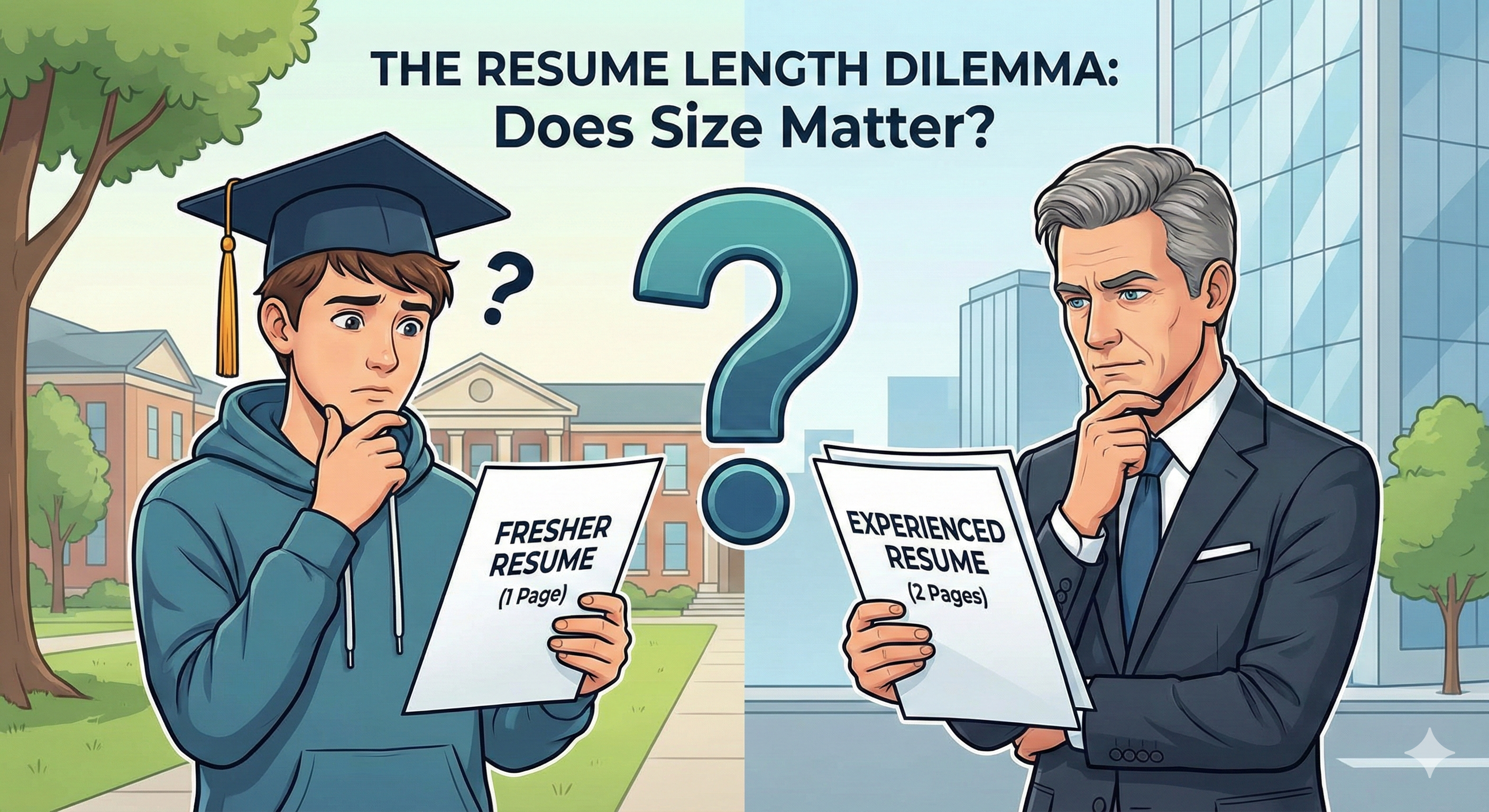
The question is as old as the modern job search itself: “How long should my resume be?” It’s the first hurdle many job seekers face, and the answer seems to shift depending on who you ask. Is the one-page rule dead? Is a two-page resume a sign of seniority or just an inability to edit?
The truth is, there is no single magic number. The ideal length of your resume depends entirely on where you are in your career and the story you need to tell. Whether you’re a fresh graduate stepping into the professional world or a seasoned veteran with decades of experience, your resume’s primary goal is the same: to convince a recruiter, in about six seconds, that you are worth an interview.
This comprehensive guide will break down the resume length dilemma, providing clear, actionable advice for both freshers and experienced candidates. We’ll debunk myths, explore the role of Applicant Tracking Systems (ATS), and show you how to craft a resume that is exactly as long as it needs to be—no more, no less.
The Golden Rule: Quality Trumps Quantity
Before we dive into specific page counts, let’s establish the most important rule of resume writing: Content is king. A concise, impactful one-page resume will always outperform a fluffy, repetitive two-page one. Conversely, a cramped one-page resume that omits crucial achievements is far less effective than a well-structured two-pager that tells a compelling career story.
Your goal is not to fill space; it is to market your skills and experience effectively. Every bullet point, every sentence, and every section must earn its place on the page by adding value and direct relevance to the job you’re applying for. If it doesn’t help prove you’re the best person for the job, cut it out.
For Freshers: The Power of the One-Page Resume
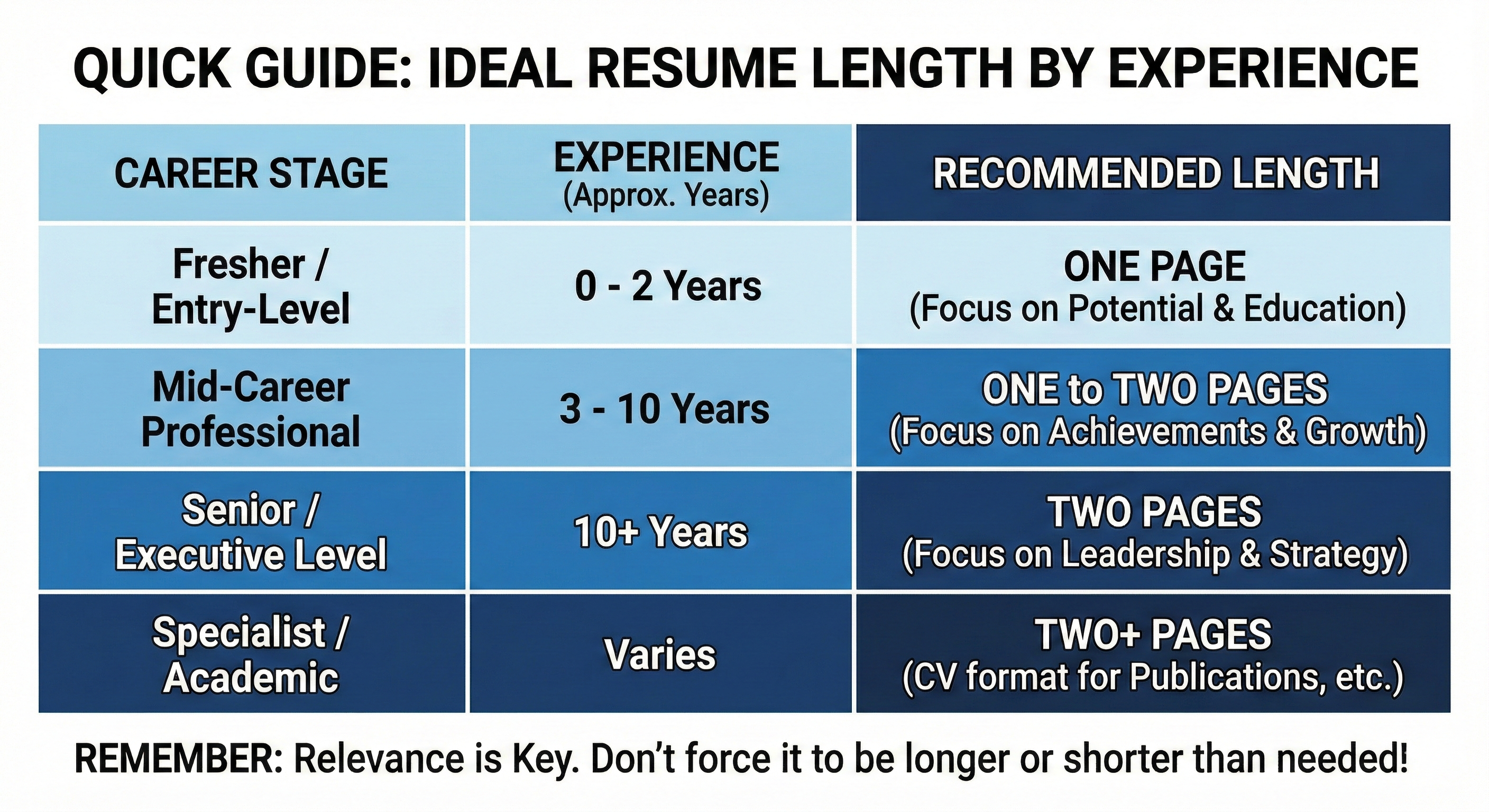
If you are a recent graduate, current student, or have less than 3-5 years of professional experience, a one-page resume is almost always your best bet.
Why?
-
Recruiters are Busy: Hiring managers for entry-level roles often receive hundreds of applications. They appreciate a concise document that allows them to quickly assess your potential.
-
Focus on Potential, Not History: As a fresher, you’re selling your potential—your education, skills, and ability to learn—rather than a long history of professional achievements. One page is sufficient to highlight these strengths without being repetitive.
-
Demonstrates Conciseness: Being able to distill your entire academic and early career life onto a single, powerful page shows strong communication skills and an ability to prioritize information—traits employers value.
What to Include in a One-Page Fresher Resume:
Since you have limited work experience, you need to leverage other areas. Your resume should be a highlight reel of your most relevant qualifications.
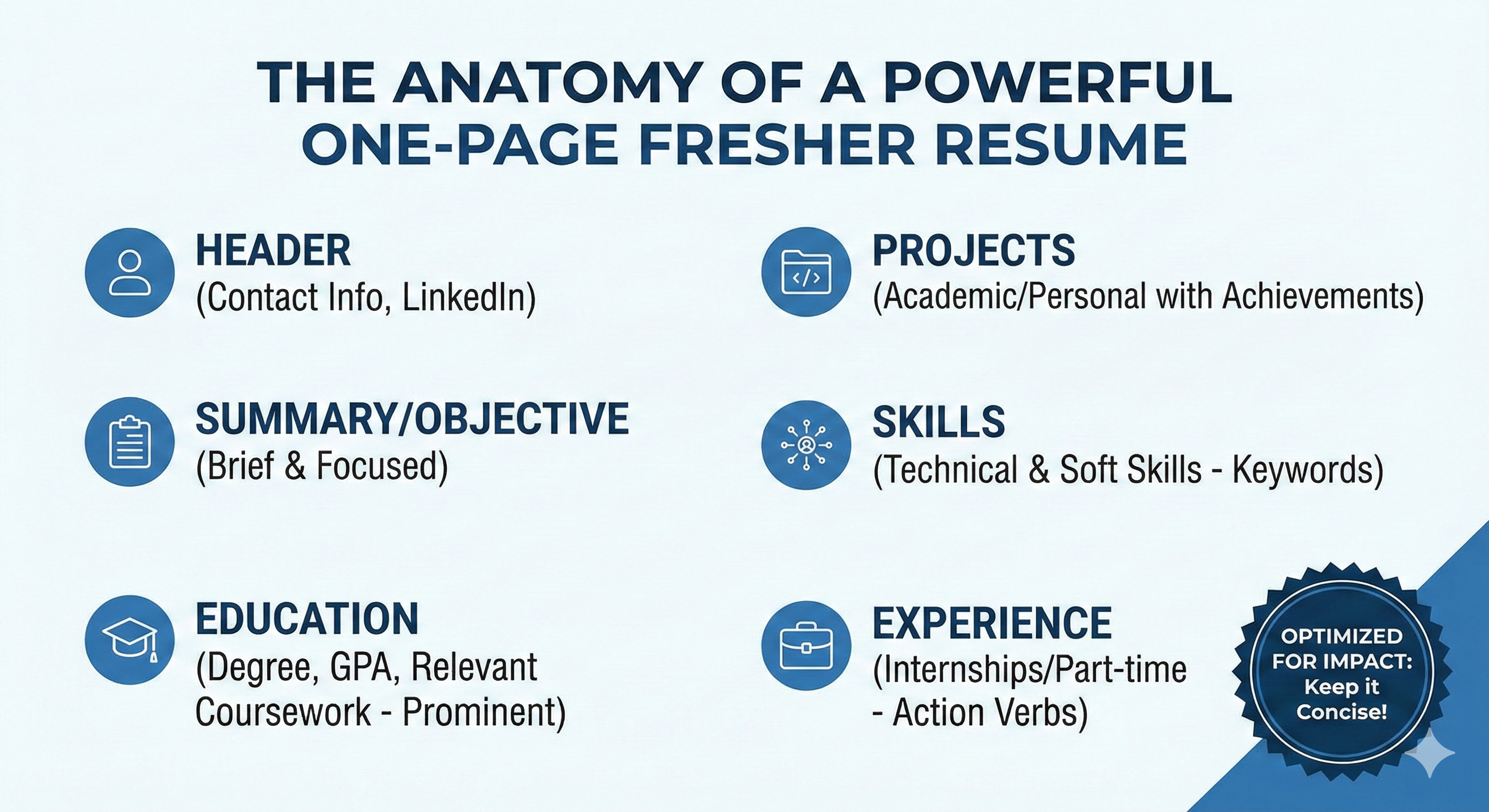
- Header: Clear contact information and a link to your LinkedIn profile or portfolio.
- Career Objective/Summary: A brief, 2-3 sentence statement outlining your career goals and what you bring to the table.
- Education: This is your strongest asset. Place it near the top. Include your university, degree, major, graduation date, and a strong GPA (if applicable).
- Relevant Coursework: List 4-6 courses that are directly related to the job you want. This shows you have the foundational knowledge.
- Projects: This is a crucial section for freshers. Detail academic or personal projects where you applied your skills. Use action verbs and quantify your results if possible (e.g., “Developed a Python-based web scraper that…”).
- Skills: Create a dedicated section for hard skills (programming languages, software, tools) and soft skills (communication, teamwork, problem-solving). These are prime spots for ATS keywords.
- Internships & Part-Time Jobs: Even if they aren’t in your target field, they demonstrate work ethic, responsibility, and transferable skills.
- Volunteer Work & Extracurriculars: Show leadership and community involvement.
For Experienced Candidates: When to Go to Two Pages (or More)
Once you cross the threshold of about 5-7 years of relevant experience, the one-page rule becomes less rigid. For mid-career professionals and beyond, a two-page resume is not only acceptable but often preferred.
Why?
- Telling a Career Story: You have a history of progression, promotions, and significant achievements that simply won’t fit on one page without sacrificing crucial details. A two-page format allows you to showcase this growth narrative.
- Depth of Expertise: You need space to detail the scope of your responsibilities, the impact of your leadership, and the measurable results you’ve achieved.
- Recruiter Preference: Many recruiters for mid-to-senior roles prefer a two-page resume because it provides a more complete picture of the candidate’s background and capabilities.
How to Structure a Two-Page Experienced Resume:
The key is to ensure the second page is as strong as the first. It shouldn’t just be a spill-over of older, less relevant roles.
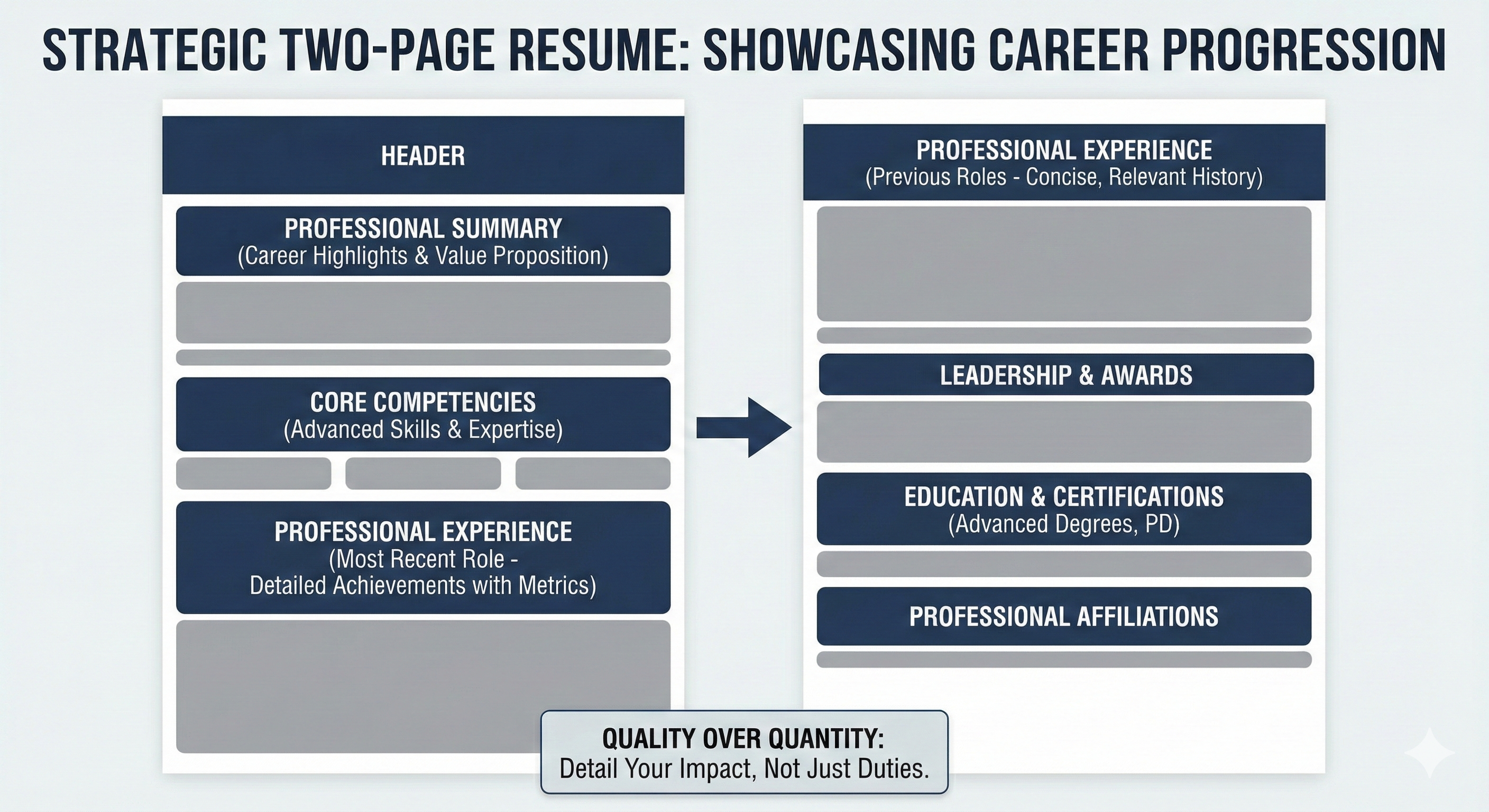
- Page 1: The Hook. The first page must contain your most compelling information. This includes a powerful professional summary, your core competencies/skills section, and your most recent and relevant professional experience. Think of page one as prime real estate.
- Page 2: The Supporting Evidence. The second page should continue your professional experience (older roles), detail your education, certifications, professional affiliations, publications, or awards.
- Consistent Formatting: Ensure your header with contact info is on both pages. Use clear headings and bullet points to maintain readability throughout.
- Focus on Achievements, Not Just Duties: Don’t just list what you were “responsible for.” Focus on what you achieved. Use the PAR (Problem, Action, Result) method to structure your bullet points. For example: “Spearheaded a cross-functional team to migrate to a new CRM system, resulting in a 15% increase in sales team efficiency.”
When is a Three-Page Resume Acceptable?
Three pages are rare but can be appropriate for:
-
Senior Executives (C-suite, VP level): With 15-20+ years of experience, a long list of leadership roles, board memberships, and strategic achievements.
-
Academic or Research Roles: A Curriculum Vitae (CV) for academia is typically much longer, detailing publications, presentations, grants, and teaching experience.
-
Highly Technical Fields: Roles that require a comprehensive list of technical skills, patents, or complex projects.
-
Federal Government Jobs: These resumes have very specific and lengthy requirements.
The Great Debate: Finding Your “Goldilocks Zone”
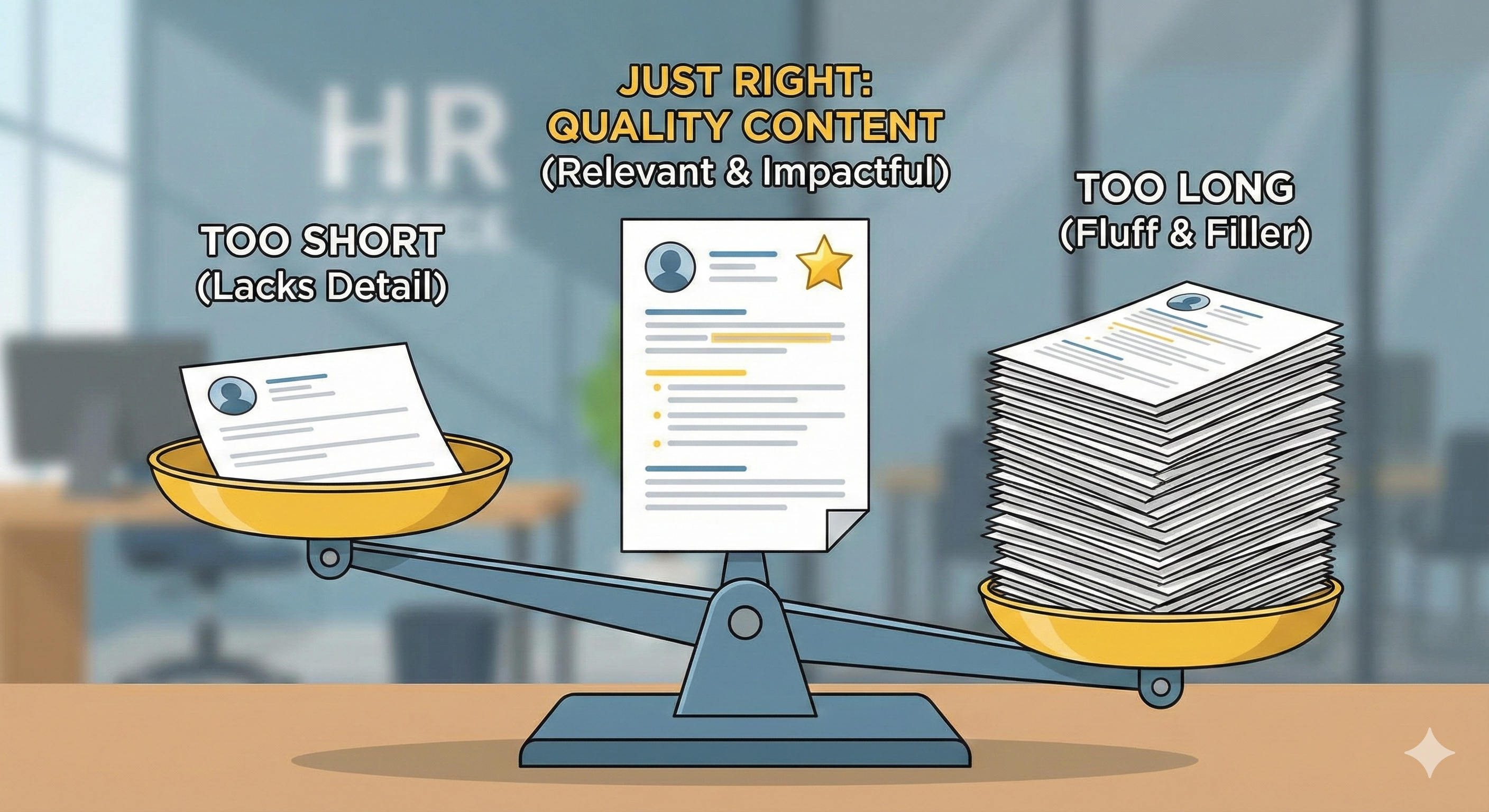
Ultimately, the debate isn’t about an arbitrary page limit; it’s about relevance and impact. You want to be in the “Goldilocks Zone” – not too short that you sell yourself short, and not too long that you bore the reader.
Think of it this way: A resume is a marketing document, not an autobiography. You don’t need to include every single job you’ve ever had since high school. You only need to include the experience and skills that are relevant to the job you are applying for right now.
If you have 10 years of experience but are applying for a career-pivot role where only your last 3 years are relevant, a one-page resume might be more powerful. Conversely, if you’re a fresher with three significant internships, leadership roles in two clubs, and a complex capstone project, a well-organized two-page resume could be better than a crammed one-pager.
The best approach is to create a “master resume” that includes everything, and then tailor a version for each specific job application, cutting out anything that isn’t directly relevant.
Practical Tips for Managing Resume Length
If Your Resume is Too Long (Cutting the Fluff):
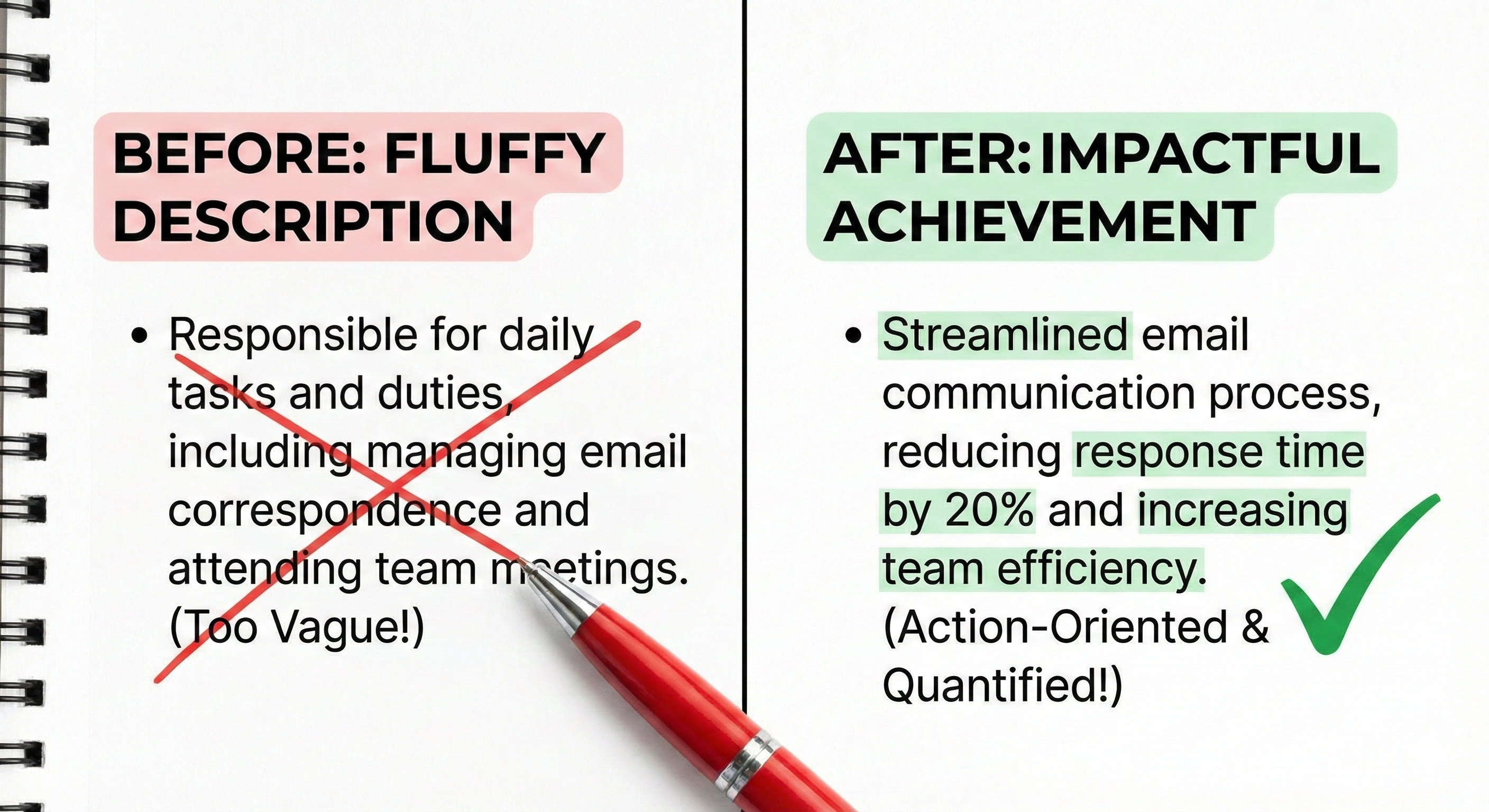
- Focus on Achievements, Not Responsibilities: Replace long lists of duties with concise, quantified achievements. Instead of “Responsible for managing social media accounts,” write “Grew social media following by 30% in six months through targeted content campaigns.”
- Remove Old/Irrelevant Experience: If you have 15 years of experience, your job from 2005 probably doesn’t need five bullet points. You can summarize older roles or even omit them if they aren’t relevant.
- Kill the “Hobbies” Section: Unless your hobby is directly relevant to the job (e.g., a photography blog for a marketing role), save the space.
- Eliminate Filler Words: Get rid of phrases like “Duties included,” “Responsible for,” and “Proven track record of.” Start bullet points with strong action verbs.
- Optimize Formatting: Adjust margins (no smaller than 0.5 inches), font size (10-12 points for body text), and line spacing to fit more onto the page without making it look cluttered.
If Your Resume is Too Short (Adding Value):
-
Expand on Projects: For freshers, academic projects are your best friend. Don’t just list the title. Explain the problem you solved, the tools you used, your role in the team, and the outcome.
-
Detail Relevant Coursework: Don’t just list course titles. Add a bullet point explaining a key project or concept you mastered in that course.
-
Add a Skills Section: Create a robust section for technical and soft skills. This is also great for ATS optimization.
-
Include Volunteer Work: This shows character and can demonstrate transferable skills like leadership and event planning.
The Invisible Gatekeeper: ATS and Resume Length
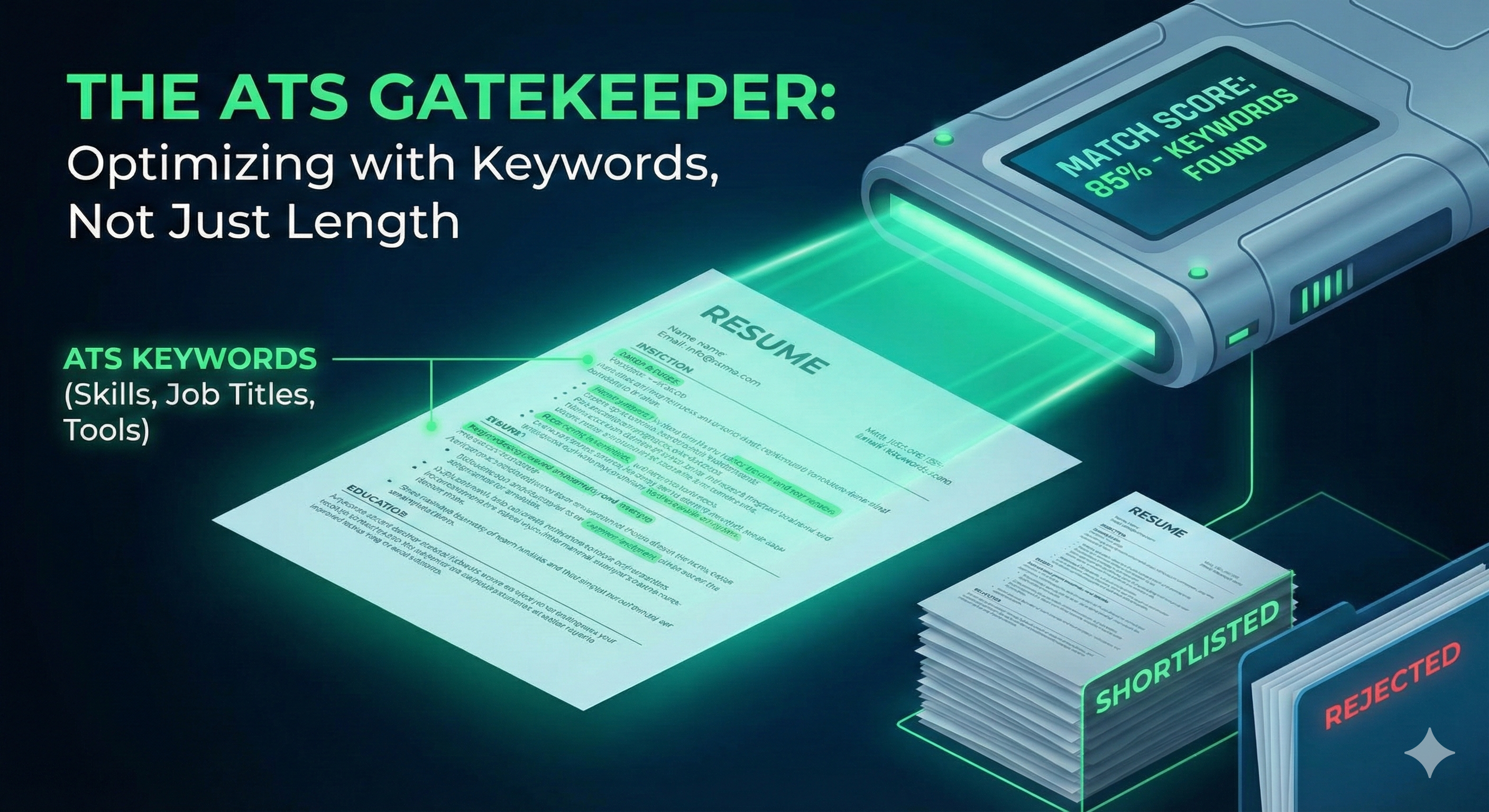
In the modern job market, your resume’s first reader is often a bot, not a human. Applicant Tracking Systems (ATS) are software used by companies to scan and filter resumes based on keywords.
Does resume length matter to an ATS? Not directly. An ATS can read a five-page resume as easily as a one-page resume. However, length matters indirectly in two ways:
-
Keyword Density: A longer resume can allow you to include more relevant keywords, which might improve your ranking. However, stuffing keywords into a resume just to make it longer will backfire. The keywords must be used naturally in the context of your skills and experience.
-
The Human Factor: Even if you pass the ATS scan, a human recruiter will eventually read your resume. If they see a four-page document full of fluff, they’ll likely discard it. The ATS gets you through the door, but the human recruiter decides if you get an interview. Therefore, the principle of quality over quantity still applies.
The best strategy for ATS is to create a resume of an appropriate length (1-2 pages) that is rich in relevant keywords found in the job description.
Conclusion: Your Resume, Your Story
There is no universal answer to the “how long should a resume be” question, but there are clear guidelines. The ideal length is whatever is necessary to tell your professional story convincingly, without wasting the reader’s time.
-
For Freshers: Master the art of the one-page resume. Make every word count.
-
For Experienced Professionals: Embrace the two-page format to showcase your career progression and depth of expertise, but ensure every section adds value.
Remember, a resume is a living document. It should evolve as your career does. Don’t be afraid to edit, refine, and tailor it for each new opportunity. By focusing on relevance, impact, and clarity, you’ll create a resume that’s not just the right length, but the right fit for landing your dream job.
Ready to build a resume that gets noticed? Start by auditing your current resume. Are you telling a compelling story, or just listing facts? Use the tips in this guide to refine your document, and remember: the best resume is one that gets you the interview. Good luck!
💡 Infalex Insight:
Your resume length ultimately doesn’t matter if it’s filled with the wrong content. Whether you’re condensing your experience down to a single page or expanding it to two, prioritize clean formatting and the right keywords. Your goal is to ensure your career story gets past the initial bot screen and into the hands of a human recruiter.
Keep Optimizing Your Job Search with Infalex:
Once you’ve nailed down the perfect length for your resume, make sure the rest of your application is flawless. Check out these other guides to keep your job search moving forward:
-
The Ultimate Guide: Best ATS Resume Format for Freshers in 2026:- Stop getting rejected by bots. Learn how to build a high-ranking, ATS-friendly resume that actually lands interviews for entry level roles in 2026.
-
Cracking the Code: Top Resume Keywords Recruiters Look for in 2026:- Unlock the secrets to getting your resume seen. Discover the essential keywords and phrases that Applicant Tracking Systems (ATS) and human recruiters look for.
-
Resume vs. CV: 5 Key Differences You Must Know to Get Hired in 2026 :- Confused between a Resume and a CV? Learn the key differences in length, content, and purpose, and discover exactly when to use each document.
-
7 Resume Mistakes Costing You Job Interviews (And How to Fix Them):- Are you applying for jobs but hearing crickets? Discover the 7 most common resume mistakes costing you interviews and learn exactly how to fix them today.
-
Stop Sending Your Resume Into a Black Hole: The ‘Invisible’ Formatting Mistake Rejection Your Application (And How to Fix It in 5 Minutes):- Is your resume disappearing into a black hole? Learn the critical reasons why Applicant Tracking Systems (ATS) reject your application and get actionable tips to fix it.
Found this helpful? Share it.