It’s a classic scenario: you’ve found a job posting that feels like it was written just for you. You’re excited, you’re ready to apply, and then you see it: “Please submit your CV or Resume.”
Wait, or? Aren’t they the same thing?
If you’ve ever found yourself staring blankly at your screen, wondering if you should send that two-page summary of your skills or the ten-page chronicle of your entire academic life, you are not alone. The terms “resume” and “CV” (Curriculum Vitae) are often used interchangeably, but they are, in fact, two very different beasts. Using the wrong one can be the difference between landing an interview and getting lost in the application black hole.
This guide will demystify the resume vs. CV dilemma once and for all. We’ll break down what each document is, highlight their key differences, and provide clear, actionable advice on when to use which. Let’s dive in!
What is a Resume? The Art of the Sales Pitch
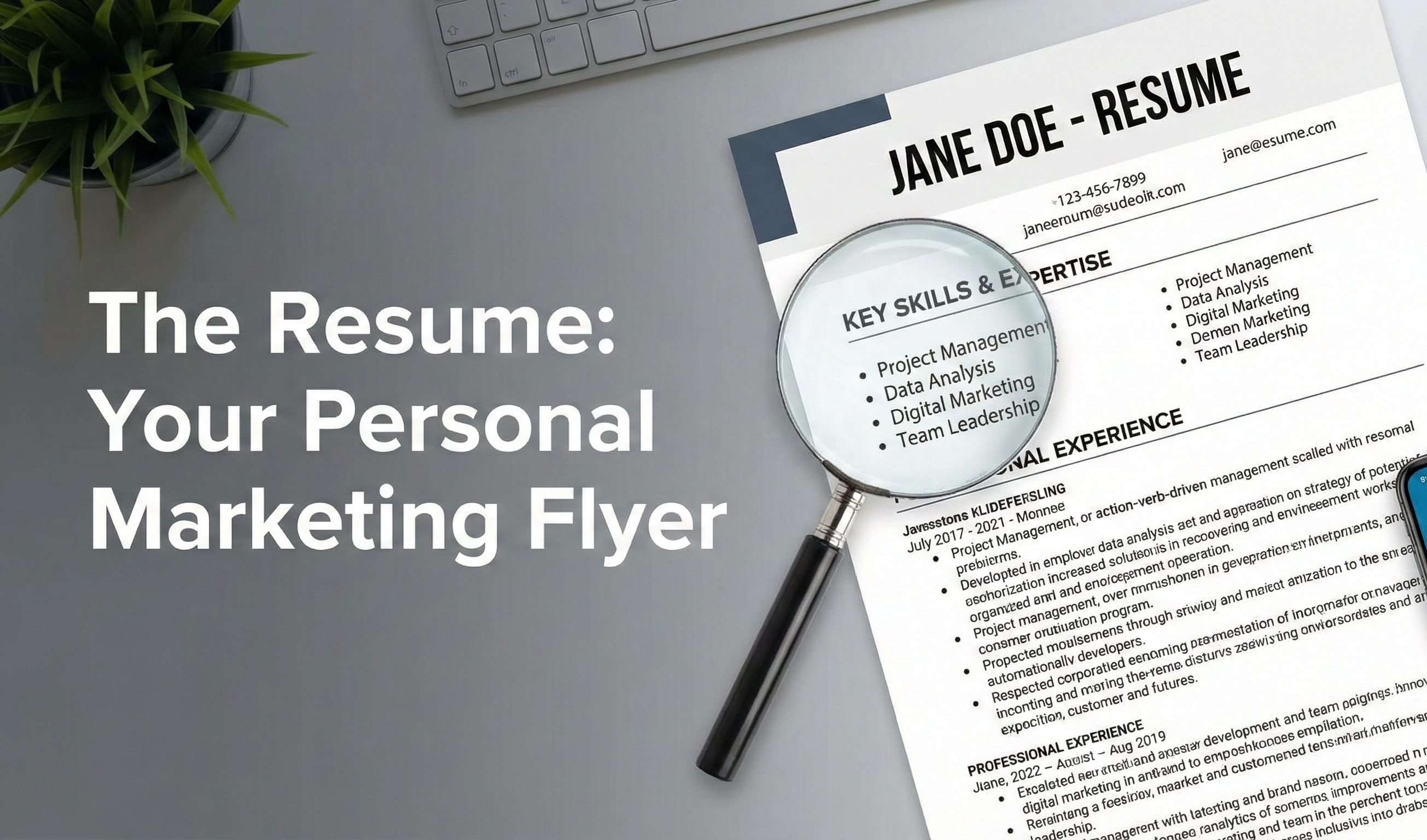
A resume (from the French word for “to summarize”) is your personal marketing flyer. Its primary goal is to get you an interview, not to tell your entire life story. Think of it as a greatest hits album – you only include the tracks that are most likely to impress your target audience.
Key Characteristics of a Resume:
- Concise: A resume is typically one to two pages long. Recruiters often spend only a few seconds scanning each resume, so brevity is key.
- Tailored: You should customize your resume for every single job application. You need to highlight the skills and experiences that directly relate to the specific role you’re applying for.
- Skills-Focused: While it includes your work history, the emphasis is on the skills you’ve gained and the achievements you’ve made. It’s about showing what you can do for a potential employer.
- Reverse-Chronological Order: Your work experience and education are listed starting with the most recent and working backward.
Typical Resume Sections:
- Contact Information: Name, phone number, email, LinkedIn profile.
- Professional Summary: A 2-3 sentence elevator pitch highlighting your value.
- Work Experience: Your job history, focusing on achievements and quantifiable results.
- Skills: A list of hard and soft skills relevant to the job.
- Education: Your highest degree and institution.
What is a CV (Curriculum Vitae)? The Academic Chronicle
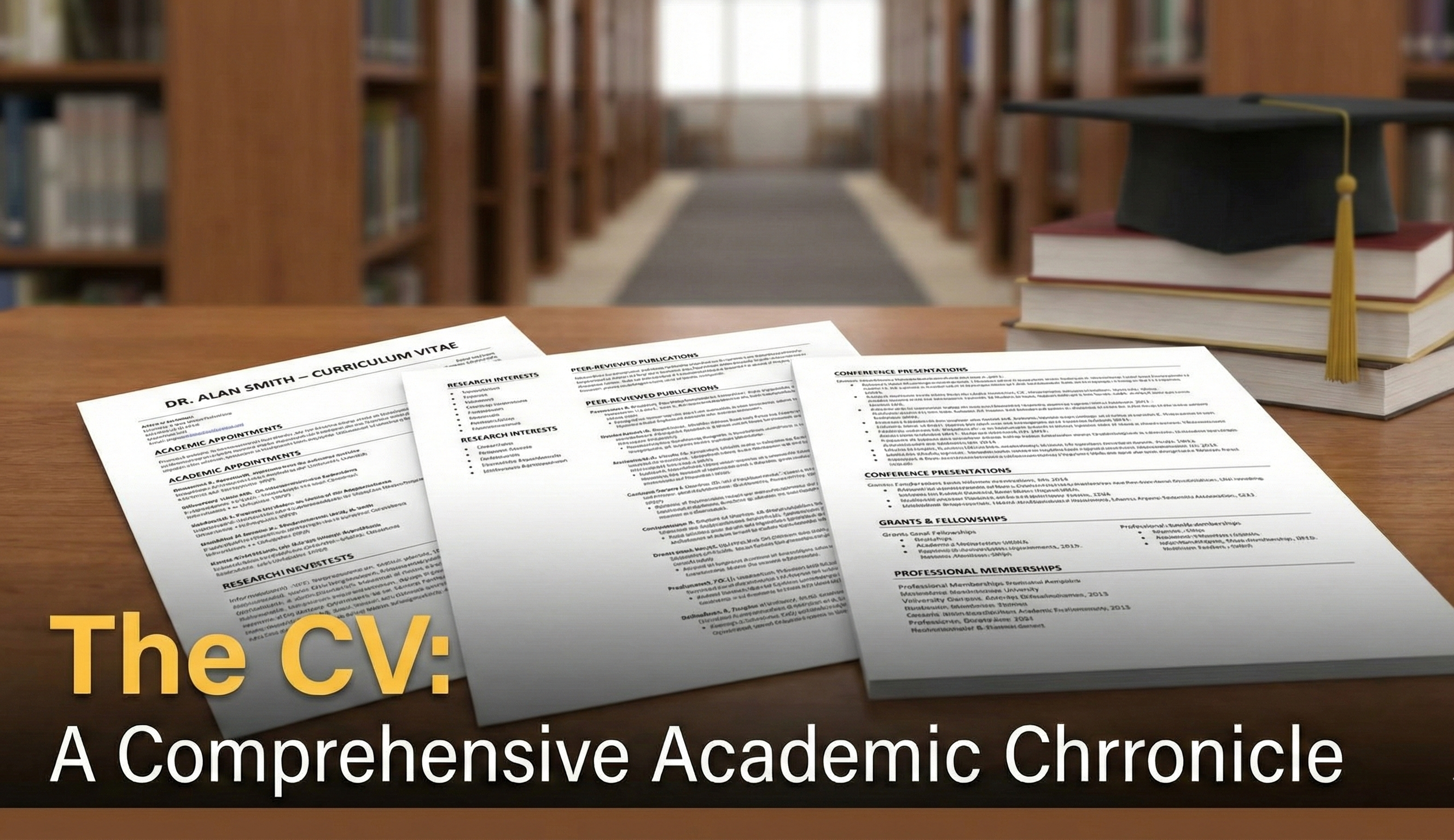
A Curriculum Vitae, Latin for “course of life,” is exactly that: a detailed, comprehensive chronicle of your academic and professional career. Unlike a resume, which is a snapshot, a CV is the full photo album. It’s designed to showcase your credentials in detail, particularly for roles in academia, research, and medicine.
Key Characteristics of a CV:
- Detailed and Long: A CV has no page limit. It can easily be two, three, or even ten pages long, depending on the length of your career. The goal is to be thorough, not concise.
- Static: While you update your CV with new accomplishments, you generally don’t tailor it for each application in the same way you would a resume. The core content remains a complete record of your history.
- Academic Focus: The emphasis is on your education, publications, research projects, presentations, honors, and awards. It’s about establishing your authority and expertise in a specific field.
Typical CV Sections:
- Contact Information
- Research Interests / Personal Statement
- Education: Detailed, including dissertation title and advisors.
- Academic Appointments / Teaching Experience
- Research Experience
- Publications: A full list of peer-reviewed articles, books, and chapters.
- Presentations: Conference talks and guest lectures.
- Grants, Fellowships, and Awards
- Professional Memberships
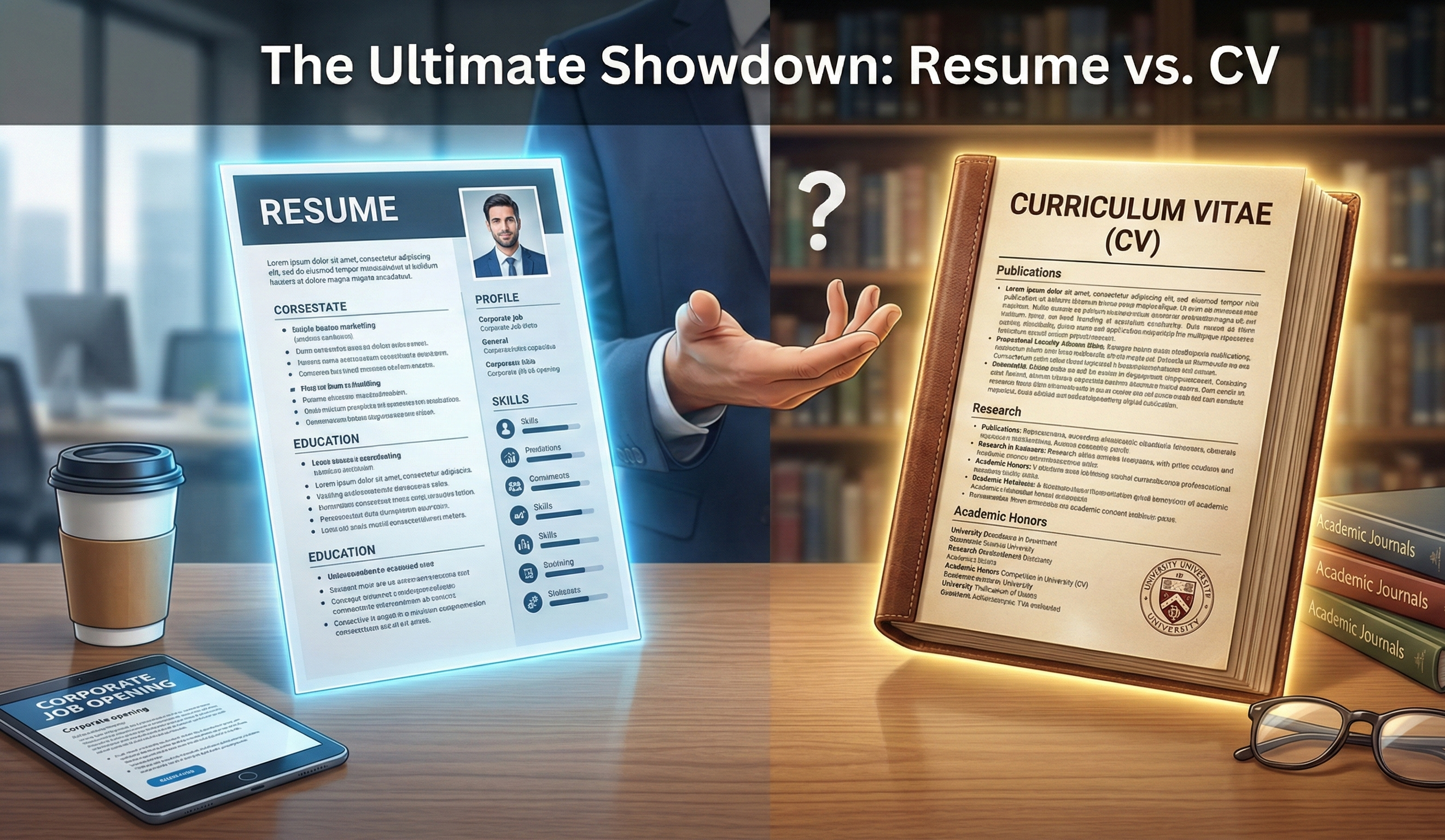
The Big Showdown: Resume vs. CV – Key Differences
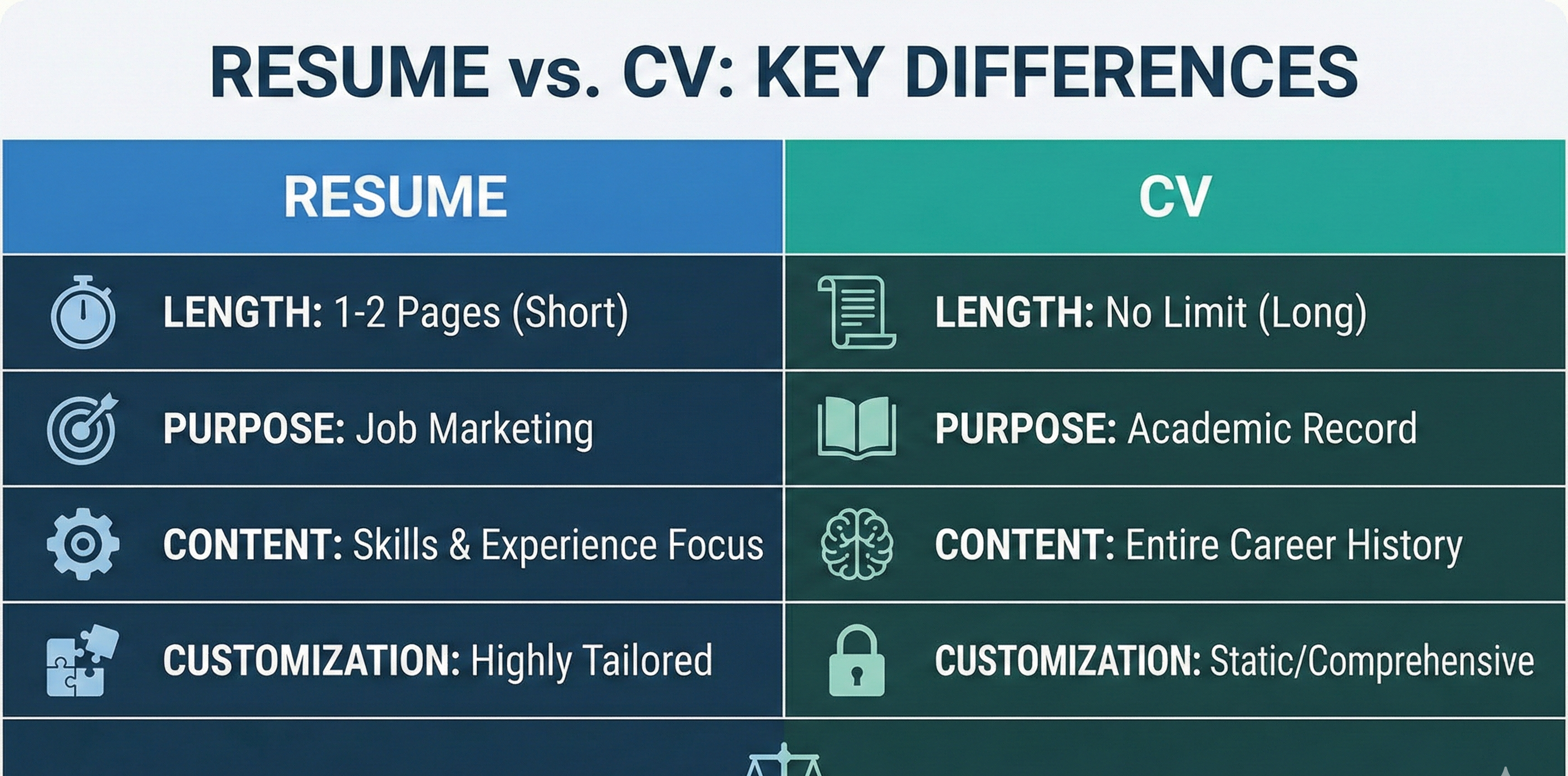
Now that we’ve defined both, let’s pit them against each other to see the differences clearly. The three main differentiators are length, purpose, and content.
| Feature | Resume | Curriculum Vitae (CV) |
|---|---|---|
| Length | Short: Typically 1–2 pages. | Long: No limit, can be many pages. |
| Purpose | Job Marketing: A summary to get an interview for a specific job. | Academic Record: A detailed chronicle of your entire career and credentials. |
| Content | Tailored & Selective: Focuses on relevant skills and work experience. | Comprehensive & Static: Includes all education, publications, awards, etc. |
| Layout | Flexible, designed for quick scanning. | Standardized, academic, list-heavy format. |
| Used In | Industry Jobs: Corporate, non-profit, government (in the US). | Academia & Research: University roles, fellowships, medical, scientific positions. |
The geographical factor is also crucial. In the United States, a resume is the standard for almost all non-academic jobs. A CV is used primarily in academia and medicine. However, in many other countries, including the UK, Ireland, Australia, New Zealand, and most of Europe, the term “CV” is used to describe what an American would call a resume – a 1-2 page summary of your career. It can get confusing, so it’s always best to understand the expectations of the specific country and industry you are applying to.
When to Use Which: Solving the Puzzle
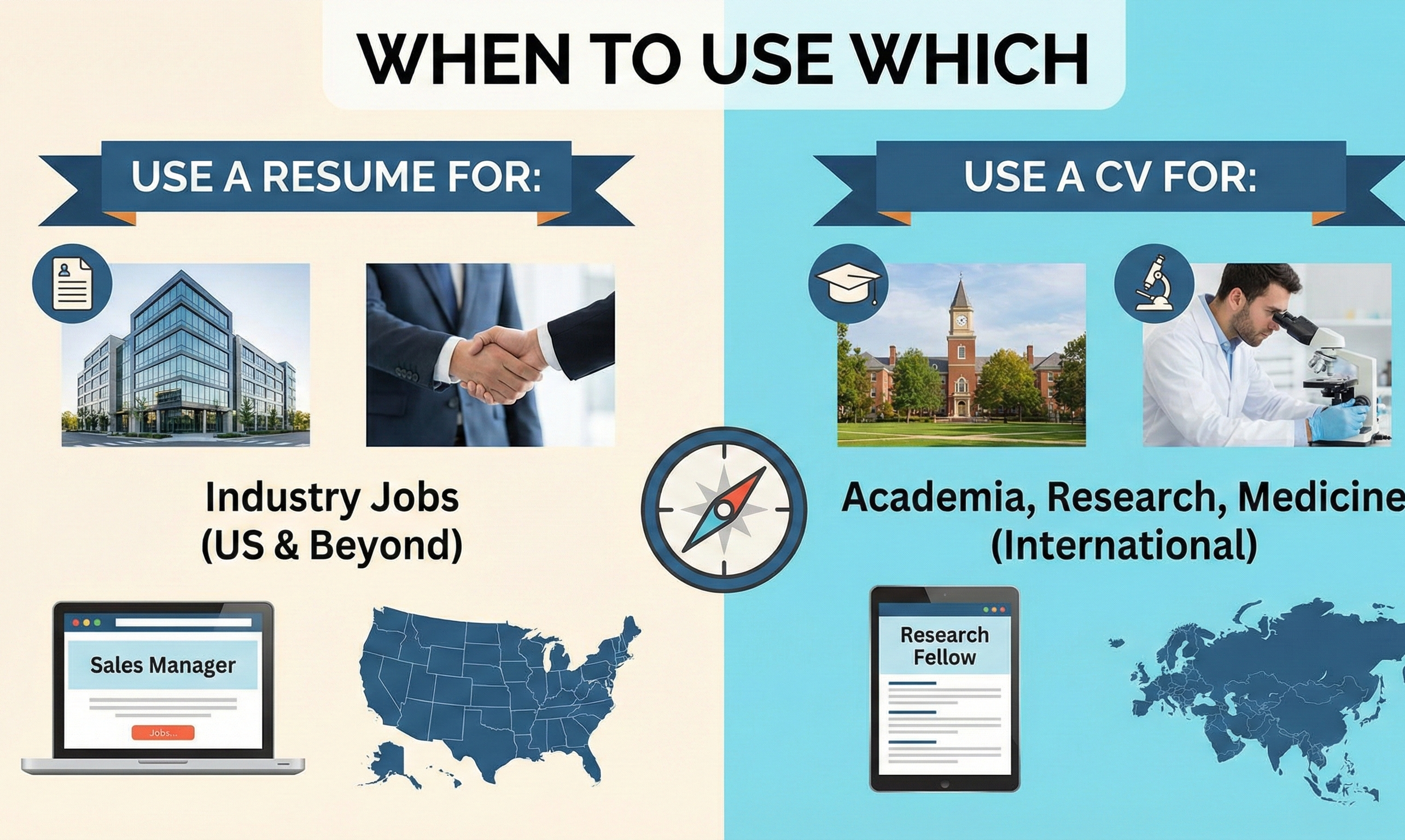
So, the million-dollar question: which one do you send? The answer depends almost entirely on what you are applying for and where you are applying.
When to Use a Resume:
- Applying for any “industry” job in the US, Canada or Worldwide: This includes roles in corporate, non-profit, startup, and government sectors. If it’s not a university or a research lab, you need a resume.
- Your goal is to demonstrate your relevant skills and experience quickly: Recruiters in these fields don’t have time to read a 10-page document. They want to see if you’re a fit in under a minute.
- You need to tailor your application to a specific job description: The flexibility of a resume allows you to swap out keywords and reorder sections to match what the employer is looking for.
When to Use a CV:
- Applying for academic positions: Think professor, lecturer, post-doctoral researcher, or university administrator roles.
- Applying for grants, fellowships, or scholarships: These applications almost always require a full account of your academic achievements.
- Applying for jobs in medicine or scientific research: These fields value a complete history of your publications, presentations, and clinical experience.
- Applying for jobs internationally (outside the US/Canada): In many parts of the world, “CV” is the standard term for the document you use to apply for any job. However, the format they expect is often a hybrid—more detailed than a US resume but shorter than a US academic CV. It’s best to research country-specific norms.
Pro Tip: If a job posting says “Resume/CV” and you’re applying for a standard industry job in the US, send a resume. If you’re applying for an academic role, send a CV. If you’re unsure, it’s perfectly acceptable to email the hiring manager or recruiter and ask for clarification.
Tips for Crafting Your Masterpiece
Whether you’re building a resume or a CV, there are some universal principles of good design and writing that you should follow.
- Focus on Achievements, Not Just Duties: Instead of just listing your job responsibilities (“Managed a team”), focus on what you accomplished (“Led a 5-person team to a 20% increase in sales quarterly”). Use numbers and data whenever possible to quantify your impact.
- Use Action Verbs: Start your bullet points with strong action verbs like “spearheaded,” “developed,” “analyzed,” and “implemented.” This makes your experience sound more dynamic and impressive.
- Keep it Clean and Readable: Use a professional font (like Arial, Calibri, or Times New Roman), clear headings, and plenty of white space. No one wants to read a wall of text.
- Proofread, Proofread, Proofread: A single typo can be the kiss of death for your application. Have a friend or mentor review your document before you send it out.
- Get Feedback: Don’t be afraid to ask for feedback from people in your industry. They can give you valuable insights into what hiring managers are looking for.
Conclusion: The Right tools for the Right Job
Understanding the difference between a resume and a CV is a crucial step in your career journey. A resume is your concise, tailored marketing pitch for industry jobs, while a CV is your detailed academic and professional chronicle for research and teaching roles.
By knowing which document to use and how to craft it effectively, you can ensure that your application stands out from the crowd and gets you one step closer to your dream job. So go ahead, choose the right tools, and present your best self to the world!

Frequently Asked Questions (FAQs)
-
Q1: What is the fundamental difference between a Resume and a CV?
A: The main difference lies in length and purpose. A Resume (Curriculum Vitae in Latin means “course of life”) is a concise, 1-2 page summary of your skills and experience tailored to a specific job. A CV is a comprehensive, static document with no page limit that details your entire academic and professional history, including publications, awards, and research. -
Q2: When should I use a CV instead of a Resume?
A: You should use a CV primarily when applying for academic roles (professor, researcher), scientific or medical positions, grants, and fellowships. For almost all other “industry” jobs (corporate, startup, government) in the US and Canada, a Resume is the standard requirement. -
Q3: Does the location of the job affect which one I should send?
A: Yes, significantly. In the United States and Canada, the terms have very distinct meanings (as described above). However, in the UK, Ireland, New Zealand, and parts of Europe, the term “CV” is often used to describe what Americans call a “Resume” (a short, 2-page summary). Always check the specific country’s norms before applying. -
Q4: How long should my Resume be compared to my CV?
A: A Resume should be brief—ideally one page if you have under 10 years of experience, and no more than two pages if you are very experienced. A CV, on the other hand, grows with your career and can be 3 to 10+ pages long, as it lists every single achievement and publication. -
Q5: Do Applicant Tracking Systems (ATS) treat them differently?
A: No, the ATS scans both for keywords. Whether you submit a Resume or a CV, the software is looking for specific terms that match the job description. However, because Resumes are tailored for specific roles, they are often easier to optimize for ATS keywords than a static, long-form CV.
🚀 Explore More Career Insights
If you found this guide helpful, we have more resources designed to help you navigate the 2026 job market with confidence. Dive deeper into these related topics:
Why Your Resume Gets Rejected by ATS (And How to Fix It) – A detailed breakdown of the exact templates and layouts that are passing the bots right now.
Best ATS Resume Format in 2026 – Discover the power words that trigger the algorithm and catch a recruiter’s eye.
Want to browse our full library of tips and tutorials? Read our latest articles on the Blog.
Final Thoughts
At Infalex, we believe that clarity is the ultimate competitive advantage. The difference between a Resume and a CV isn’t just about length or formatting—it’s about knowing which tools will best tell your story to the right audience.
Whether you are crafting a punchy one-page resume to land a corporate role or compiling a detailed CV for an academic fellowship, the goal remains the same: to get your foot in the door. We hope this guide has replaced confusion with confidence, empowering you to choose the right document for your next big opportunity. Now, go hit that “Apply” button—you’ve got this!
Found this helpful? Share it.